
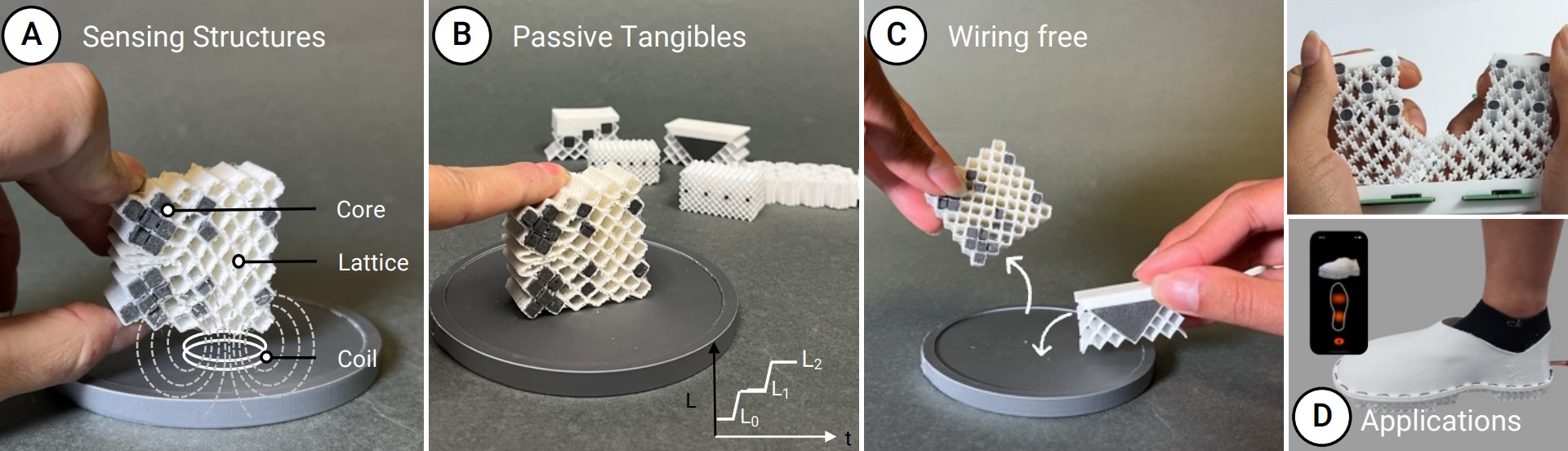
In this paper, we explore the design and development of passive soft 3D-printed structures whose deformation can be sensed accurately without any wired connection. By 3D printing tangible interfaces consisting of flexible TPU (thermoplastic polyurethane), made from lattice structures with bespoke geometries and mechanical properties, and ferromagnetic elements using metal-infused filaments, we enable the detection of structural deformations through inductive sensing. We investigate how different ferromagnetic core configurations within flexible substrates, guided by key design parameters, influence the sensitivity, responsiveness, and deformability of the sensing system. We demonstrate that our 3D-printed inductive sensing approach allows users to switch their fully passive tangible interfaces for specialized tasks without assembly or the need to unplug wires. Our sensing approach can be integrated in portable applications, such as a smart bottle cover that captures subtle deformation to measure liquid intake, or in wearable applications, such as monitoring foot pressure in smart shoes.
Publication
Rahul Bhaumik, Camilo Ayala-Garcia, Niko Münzenrieder, Michael Haller, Alexandra Ion. 2026. InSense3D: Designing Smart 3D-Printed Structures Leveraging Ferromagnetic Filaments for Inductive Deformation Sensing. In Proceedings of CHI ’26. Barcelona, Spain. April 13–17, 2026. DOI: https://doi.org/10.1145/3772318.3791824